

Spiral Dynamics is the result of extensive longitudinal research spanning more than two decades, conducted by Clare W. Graves. Her theory, initially called the emergent cyclic theory of human development, later became popularized as spiral dynamics. Through questionnaires, interviews, and experiments with thousands of participants, Graves identified sequential patterns in the evolution of people’s values in response to changes in their living conditions.
This work was continued and expanded by Don Beck and Christopher Cowan, who applied the concepts of Spiral Dynamics to more than 50 global companies, including IBM and British Airways. Their research validated that the value systems identified by Graves were not only manifested at the individual level, but were also reflected in the collective dynamics of groups and organizations.
Spiral Dynamics: A Map for Navigating Human Complexity
It could be said that it is a powerful tool that allows us to understand the evolution of values and thought systems in individuals and organizations. The theory integrates concepts from disciplines such as psychology, sociology, anthropology, and economics, making it a useful tool for analyzing and transforming organizations. Through an eight-level development model, each represented by a color, Spiral Dynamics reveals how people and groups adapt to their environment and make decisions.
The Five Premises of Spiral Dynamics
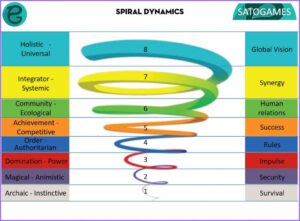
- Human nature is neither static nor limited. It changes with the evolution of the conditions of existence, creating new systems while old ones continue to exist.
- When a system is activated, humans tend to change their perception of reality. This includes their thought processes and life norms in order to adapt to the new circumstances.
- Human beings live within an open system of values. This system is not a final condition, but a constant process of adaptation and change.
- Each upward turn of the spiral marks the evolution towards a more complex version.
- A double-spiral vortex represents the movement of human systems. This movement implies constant evolution through levels of increasing complexity.
How to leverage spiral dynamics to understand the evolution of organizations
- Adaptive process: Humans and societies evolve in response to the needs and challenges of their environment, adapting to the prevailing living conditions.
- Emergent cycles: Each level of the spiral dynamic represents a value system that emerges, reaches a peak, enters a crisis, and transforms into the next level in a continuous process.
- Coexistence of levels: Although an individual or organization operates at a specific level, the previous values remain present and influential, allowing the coexistence of different levels.
- Appropriate levels: There are no “better” or “worse” levels; each one aligns with the needs of the moment.
- Tension-driven transition: Changes are triggered by tension between unresolved problems and new opportunities, often marked by internal crises or external pressures.
Why is it relevant for organizational leaders?
- As leaders, our effectiveness depends on our ability to connect with our teams, motivate them, and guide them toward a common goal. Spiral Dynamics provides us with a framework for:
- Understanding the diversity of perspectives: Each level of the Spiral Dynamics represents a different way of seeing the world. By recognizing and respecting these differences, we can build more inclusive teams and harness the richness of diversity.
- Adapting our leadership style: There is no single leadership approach that works for everyone. Spiral Dynamics helps us adapt our style to the needs and values of each person or team.
- Fostering collaboration and commitment: By understanding the values that drive our employees, we can create a work environment where they feel valued, motivated, and committed to the organization’s mission.
- Managing change effectively: The Spiral Dynamics model shows us how people and organizations react to change. By anticipating these reactions, we can implement smoother and more successful change strategies.
The colors of the spiral dynamic and its levels of existence
Each level of development, also called existence, is represented by a color; these are:
- Beige (Survival): The first level, focused on survival and basic needs.
- Purple (Magical-Animistic): A world of spirits and rituals, where traditions and customs are fundamental.
- Red (Impulsive): Power and action dominate, with a focus on the present and the satisfaction of desires.
- Blue (Authoritarian): Order and structure are key, with clear rules and established hierarchies.
- Orange (Achievement): Success and progress are the driving forces, propelling competition and innovation.
- Green (Community): Harmony and human connection are priorities, seeking consensus and collaboration.
- Yellow (Systemic): Complexity and change are recognized, seeking comprehensive and flexible solutions.
- Turquoise (Holistic): The last level, where consciousness expands towards a global and transcendent vision.
Stay tuned!
From now on, each week you can read an article delving deeper into each color (level of human development) for transforming your leadership. In the next article, we’ll dive into the first level of the Spiral Dynamics, represented by the color Beige. We’ll discover the fundamentals of survival and how they influence human behavior.
Don’t miss this series!


