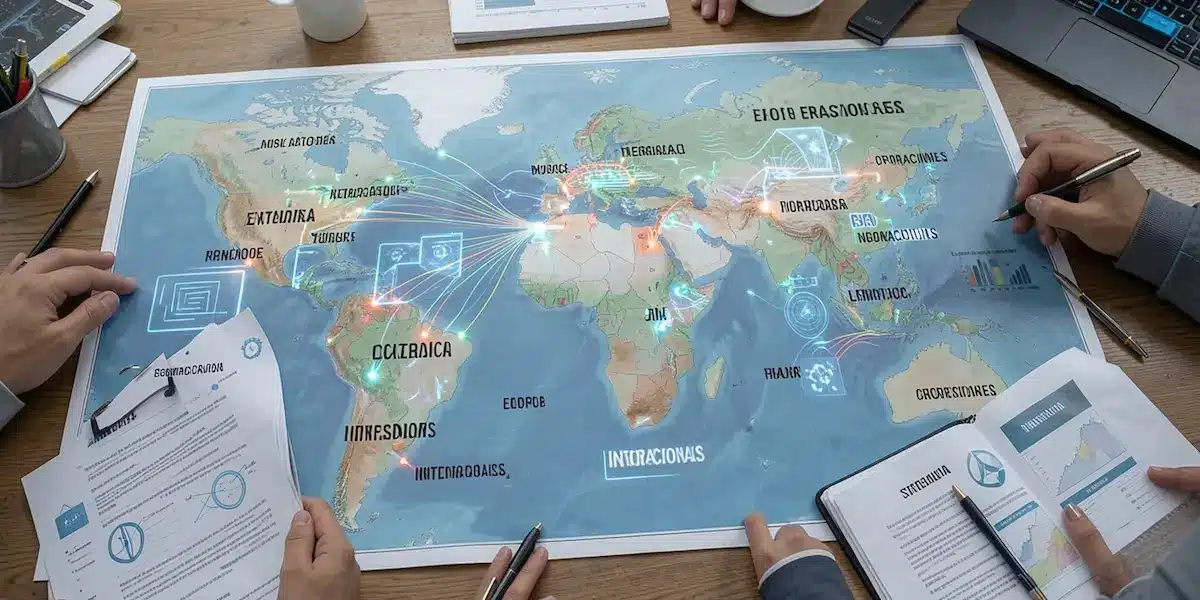
Growing a business in the domestic market has a natural ceiling. When customer acquisition rates begin to plateau and market saturation sets in, international expansion becomes the logical next step for sustaining growth. Yet for middle managers and operational leaders, this decision often raises immediate concerns.
Why? Traditionally, expanding across borders meant multiplying workloads, navigating unfamiliar regulations, and managing a level of operational complexity capable of overwhelming even the most efficient teams.
Today, however, the landscape has changed. The convergence of digital transformation and international expansion is no longer reserved for multinational corporations with unlimited budgets. Thanks to Artificial Intelligence (AI) and cloud-based infrastructures, team leaders now have access to the tools required to enter new markets quickly, sustainably, and with complete visibility over operations.
The Traditional Cross-Border Growth Bottleneck
Under the traditional expansion model, internationalisation required companies to replicate physical or organisational structures in each target country. For middle managers, this often meant coordinating new warehouses, managing fragmented communication systems, and hiring local staff to provide basic support across multiple time zones.
This decentralised approach created a cycle of micromanagement that undermined B2C scalability. Instead of focusing on market positioning and growth strategies, operations directors and department heads found themselves consumed by logistical issues, compliance challenges, and language barriers.
The outcome was predictable: processes that struggled to function across borders and internal teams burdened by the pressure of maintaining what effectively became two separate businesses. Modern technology is designed to eliminate this friction.
Three AI Capabilities Accelerating International Business Expansion
For digital transformation and international expansion to succeed, the underlying infrastructure must be seamless, scalable, and highly automated. AI enables organisations to centralise strategic decision-making while decentralising execution without increasing headcount.
Here are three critical areas where AI acts as a growth accelerator.
1. Hyper-Localised Multilingual Customer Support
Customer service remains one of the biggest challenges when entering a new market. Advanced conversational AI and large language models enable businesses to deploy virtual assistants capable of resolving up to 80% of first-line enquiries in the customer’s native language.
These systems understand regional expressions, cultural nuances, and local expectations in real time, allowing businesses to provide 24/7 support without immediately investing in local customer service departments.
2. Cloud-Based Predictive Logistics
Cloud platforms powered by predictive algorithms analyse historical purchasing patterns alongside destination-market trends.
This enables operations managers to forecast demand more accurately, optimise cross-border distribution routes, and significantly reduce warehousing costs. The result is a more efficient supply chain and a stronger ability to deliver on customer expectations regardless of location.
3. Large-Scale Catalogue Localisation and Adaptation
Launching an e-commerce operation in a new country requires far more than translation. Businesses must adapt pricing, product descriptions, payment systems, and regulatory labelling requirements.
AI-powered tools automate contextual translation, currency conversion, and content localisation, enabling thousands of product references to be adapted within hours rather than weeks. This ensures a seamless customer experience from day one while reducing operational workload.
Process Automation: The Key to Retaining Strategic Talent
Whenever advanced technology enters the conversation, concerns about workforce displacement often follow. In reality, within middle-management environments, operational automation serves a very different purpose: empowering people to focus on higher-value activities.
By delegating repetitive administrative tasks, data processing, and alert management to intelligent systems, organisations free their teams from unnecessary bureaucracy.
High-performing professionals do not want to spend their days validating international postcodes or manually translating support emails. They want to analyse consumer behaviour, develop market-entry strategies, and lead initiatives that drive measurable business impact.
Providing employees with cutting-edge tools to manage international growth reduces workplace stress and transforms expansion projects into valuable professional development opportunities. This has a direct and positive effect on strategic talent retention.
From Operational Managers to Architects of Global Growth
Today, international success is no longer measured by the number of physical offices a company maintains overseas. Instead, it is determined by the agility, intelligence, and scalability of its digital systems.
For middle managers, leading digital transformation and international expansion through AI represents an opportunity to move beyond the role of operational firefighter and become a genuine architect of organisational growth.
Scalability becomes achievable when technology works for the team, rather than forcing the team to work around technology.
Is Your Business Ready to Expand Internationally Without Losing Operational Control?
Designing a digital architecture that integrates Artificial Intelligence while ensuring scalable and efficient operations should not be left to trial and error.
At Sibega, we help middle managers, operations leaders, and growing businesses build the technological foundations required for successful international expansion. Our approach enables organisations to scale confidently, improve performance, and safeguard the wellbeing of their teams.
Book a consultation with Sibega today and discover how to transform your local operation into an intelligent, globally scalable business.